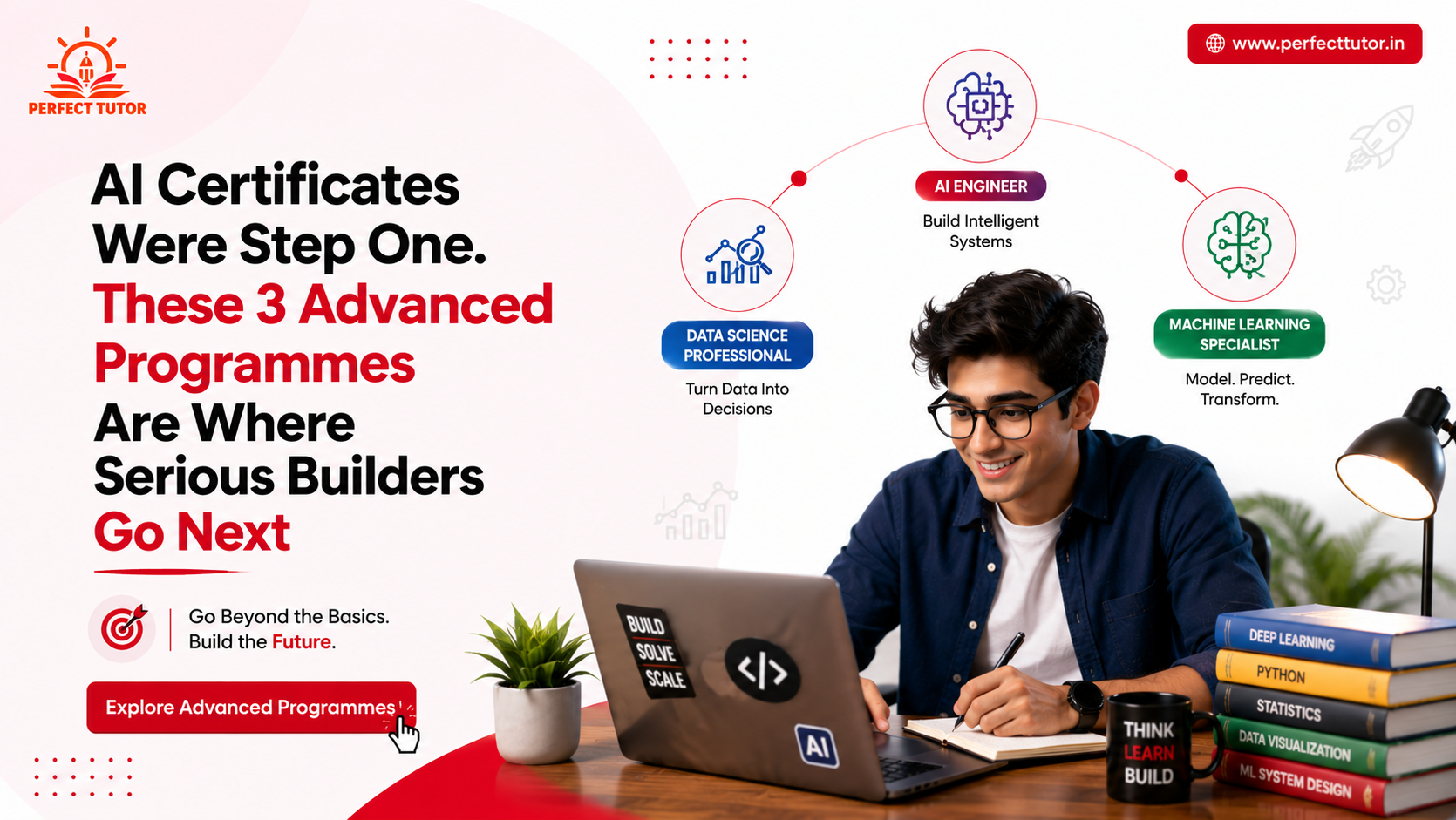
AI Certificates Were Step One. These 3 Advanced Programmes Are Where Serious Builders Go Next

A few years ago, completing an AI certificate was enough to signal initiative. Today, it barely gets you through the first filter.
The rapid growth of online learning has made artificial intelligence education more accessible than ever. Millions of professionals have completed introductory courses in machine learning, data science, generative AI, and prompt engineering through platforms such as Coursera, Udemy, edX, and other learning providers. Yet as AI adoption accelerates, employers are increasingly discovering a gap between certification and real-world capability.
That shift is becoming evident across the job market. India's Global Capability Centres (GCCs) are projected to employ 2.36 million professionals by FY2026, while 73% of HR leaders report a widening skills gap between available talent and industry needs. Companies are no longer looking only for professionals who understand AI concepts, they want people who can build, deploy, and scale AI systems that create measurable business value.
This changing demand is giving rise to a new generation of programmes across AI engineering colleges in India. Unlike introductory certifications, these advanced AI degree courses and AI degrees are designed around implementation, combining technical depth with hands-on product development, deployment, and real-world problem-solving.
For professionals wondering what comes after AI certifications, these three programmes represent some of the strongest next steps.
1. Masters' Union
Most AI certificates teach individual concepts or tools in isolation. Masters' Union's Postgraduate Programme in Applied AI & Agentic Systems (PGP AIAS) is designed around a different objective: helping learners understand how complete AI products are conceived, built, deployed, and continuously improved. Instead of treating AI as purely an engineering discipline, the 15-month, full-time, on-campus programme combines AI engineering, product, and business, reflecting the intersectional roles the market is increasingly hiring for, from AI Product Managers to Forward Deployed Engineers.
Rather than progressing through disconnected modules, students first build strong AI and machine learning foundations before specialising in one of three pathways: AI Product, Advanced AI/ML & Systems, or AI Entrepreneurship. Every term culminates in building a real AI product, enabling graduates to leave with six production-grade AI systems across autonomous AI agents, enterprise AI deployments, Retrieval-Augmented Generation (RAG) pipelines, knowledge graphs, fine-tuned frontier and open-source models, and agentic AI applications. Recognising that AI evolves faster than traditional curricula, the programme is updated every quarter to incorporate the latest technologies, frameworks, and enterprise use cases.
The learning environment closely mirrors industry practice. Alongside build studios, hackrooms, collaborative product sprints, and mentorship from more than 200 founders, CTOs, and AI practitioners, students spend the final terms working on frontier projects, from deploying their own Small Language Models (SLMs) and multi-agent enterprise systems to building Physical AI solutions or launching AI ventures through the Venture Initiation Program.Among emerging AI engineering colleges in India, the programme offers a distinctly different model of AI education by combining full-time immersive learning, continuously updated curriculum, and real-world product building in a way no other programmes currently do.
2. IIIT Bangalore
For professionals looking to move beyond introductory AI certifications and develop deeper technical expertise, IIIT Bangalore offers a strong academic pathway grounded in both research and industry relevance.
Over the years, IIIT Bangalore has established itself as one of India's leading technology institutions, with a strong focus on computer science, artificial intelligence, and data-driven innovation. Its AI and Machine Learning programmes are designed to help learners build a rigorous understanding of concepts such as machine learning, deep learning, natural language processing, computer vision, and generative AI, while applying these skills to real-world challenges.
A key differentiator is the institute's emphasis on balancing theoretical foundations with practical implementation. Through hands-on projects, case studies, and industry-oriented coursework, learners gain exposure to how AI technologies are deployed across sectors. For engineers and technology professionals seeking to strengthen their technical depth, IIIT Bangalore offers one of the more established AI degrees for professionals looking to build long-term expertise in artificial intelligence.
3. Indian Institute of Technology Madras
The Indian Institute of Technology Madras holds a strong position among AI engineering colleges in India, backed by academic rigour and its Research Park ecosystem that connects academia with industry. For software engineers navigating career transitions, it offers a structured entry point into applied AI with a clear business orientation.
Its Executive Programme in Generative AI and Agentic AI Tools for Business is a four-month AI degree course designed for working professionals, requiring 8 to 10 hours per week.
The curriculum focuses on building AI-driven workflows using no-code and low-code tools across business use cases, helping professionals quickly translate AI concepts into functional applications within their existing roles. Among the top colleges for AI in India, IIT Madras reflects a more application-led pathway.
It supports professionals looking to integrate AI into ongoing work rather than fully transition into core AI engineering roles. While it offers practical exposure, the depth of continuous system building and production-level execution remains relatively limited.
AI Engineering Colleges in India Are Moving Beyond Certifications
The next phase of AI education is no longer defined by how many certifications professionals collect, but by how effectively they can translate knowledge into real-world systems. As organisations increasingly evaluate portfolios, deployed applications, and implementation capability, AI engineering colleges in India are rethinking how postgraduate learning is delivered.
Programmes such as Masters' Union's Post Graduate Programme in Applied AI & Agentic Systems reflect this broader evolution by combining technical learning with continuous product development and industry immersion throughout the journey. Alongside more traditional AI degrees offered by institutions such as IIIT Bangalore and IIT Madras, they illustrate how the modern AI degree course is moving beyond classroom instruction to prepare professionals for the realities of building, deploying, and scaling AI solutions.
For learners who have already completed AI certifications, that practical experience may increasingly become the distinction that matters most.