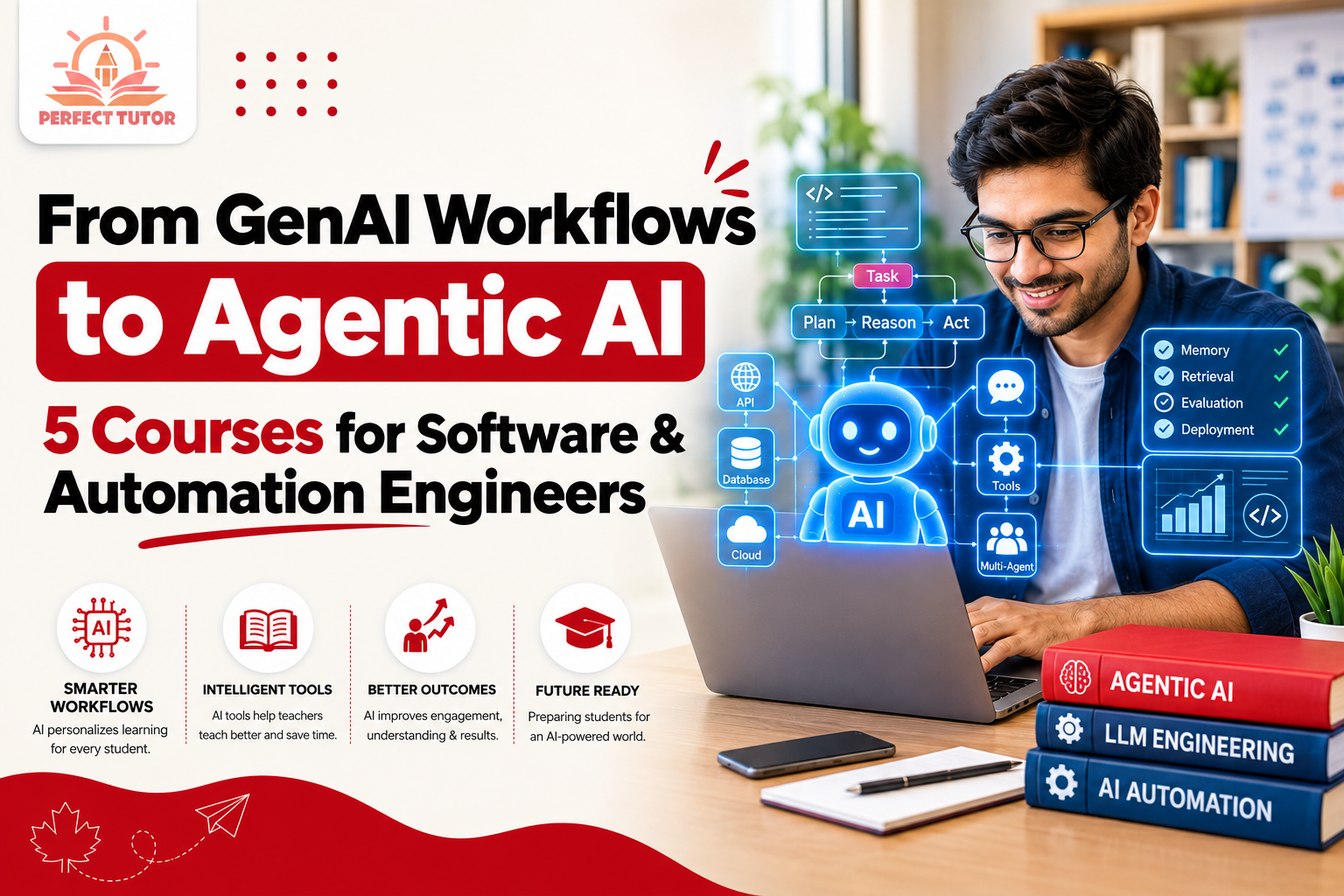
From GenAI Workflows to Agentic AI: 5 Courses for Software and Automation Engineers

From GenAI Workflows to Agentic AI: 5 Courses for Software and Automation Engineers
Software automation is moving beyond scripts and rule-based workflows. Engineers increasingly combine APIs, LLMs, retrieval systems, external tools, and orchestration layers to build applications that can interpret a task and decide what happens next.
That changes the learning path, too. Prompt engineering and RAG are useful starting points, but production-oriented systems also require memory, planning, tool calling, multi-agent coordination, evaluation, guardrails, and deployment.
The five courses below approach this transition differently. Some concentrate directly on agent engineering, while others build the deeper AI, machine learning, and deployment foundation needed for larger automation systems.
5 Courses for Software and Automation Engineers
# | Program & Provider | Duration | Best Aligned With |
|---|---|---|---|
1 | Certificate in Agentic AI - IIT Bombay | 5 months | Agent architecture, MCP, multi-agent systems |
2 | Professional Certificate in Generative & Agentic AI - BITS Pilani Digital | ~30 weeks | RAG, workflow automation, production AI |
3 | e-Postgraduate Diploma in Artificial Intelligence and Data Science - IIT Bombay | 18 months | ML, GenAI, deployment, data science |
4 | Certification Program in Applied Generative AI and Agentic AI - TalentSprint | 18 weekends | GenAI applications and enterprise automation |
5 | Advanced Certification Programme in Agentic and Generative AI - CCE-IISc with TalentSprint | 6 months | LLMs, agents, safety, LLMOps |
1. Certificate in Agentic AI - IIT Bombay
This Agentic AI Course is designed around the architecture of autonomous systems rather than treating agents as a short extension of Generative AI. The curriculum starts with Python, APIs, LLM fundamentals, transformers, and prompting, then moves into tool-connected workflows, memory, reasoning, orchestration, and deployment.
Delivery & Duration: Five months, fully online, with live interactive sessions from IIT Bombay faculty, guided labs, projects, and peer learning.
Program Highlights: RAG, vector databases, MCP, LangGraph, CrewAI, CoT, ReAct, reflection, DSPy, multi-agent coordination, human-in-the-loop systems, prompt security, guardrails, LangSmith, FastAPI, Streamlit, and Docker. Projects include a financial-news analyst agent, RAG customer-support system, collaborative event-planning agents, and a multi-agent software engineering team.
Outcomes: Learners develop agents that can reason, plan, use tools, retain workflow context, collaborate across multi-step tasks, and operate with monitoring and safeguards.
Why should you choose this course?
- The projects mirror actual agent workflows. The software engineering project covers code execution, testing, error correction, ReAct, and collaboration between specialized agents.
- Deployment is part of the curriculum. Agent design continues into security, evaluation, human oversight, APIs, application interfaces, and containerized deployment.
2. Professional Certificate in Generative & Agentic AI - BITS Pilani Digital
BITS Pilani Digital takes a systems-engineering approach to GenAI. Learners move from LLMs and prompting into retrieval, autonomous agents, workflow execution, testing, and deployment rather than studying individual tools separately.
Delivery & Duration: Approximately 30 weeks using a flipped-classroom format with self-paced preparation, labs, and structured live sessions.
Program Highlights: LLMs, embeddings, vector search, RAG, LangGraph, LangChain, MCP, n8n workflow automation, evaluation harnesses, hallucination testing, regression testing, Langfuse, Docker, AWS deployment, Streamlit, and Flask.
Outcomes: Learners connect intelligence, retrieval, reasoning, actions, evaluation, and deployment into complete AI systems, not isolated prototypes.
Why should you choose this course?
- Workflow automation receives dedicated attention. n8n, APIs, MCP, approvals, exception handling, and application layers connect agent reasoning to real actions.
- Reliability is treated as engineering work. Evaluation, observability, security, latency, cost, and failure testing are built into the learning path.
3. e-Postgraduate Diploma in Artificial Intelligence and Data Science - IIT Bombay
For professionals looking for an IIT Bombay AI ML course with broader academic depth, this 36-credit diploma starts well before Agentic AI. Programming, statistics, machine learning, deep learning, Generative AI, cloud infrastructure, and deployment form the technical base.
Delivery & Duration: Typically 18 months, with six IIT Bombay courses. Live faculty sessions run on weekday evenings and weekends, and candidates complete in-person end-term examinations at IIT Bombay.
Program Highlights: Python, SQL/NoSQL, big data, statistical ML, regression, clustering, classification, feature engineering, transformers, LLMs, fine-tuning, TensorFlow/Keras, PyTorch, Docker, Kubernetes, cloud deployment, and an AI-ML capstone. Learners also choose an elective in areas such as NLP, IoT, or computer vision.
Outcomes: Graduates learn to build, validate, deploy, and communicate end-to-end AI/ML solutions rather than working only at the application layer.
Why should you choose this course?
- It goes deeper than GenAI applications. Statistical foundations, machine learning, data pipelines, and deep learning precede deployment.
- The AI-ML in Practice course closes the implementation gap. It covers cloud scaling, Docker, Kubernetes, transfer learning, ensembles, and a term-long group capstone.
4. Certification Program in Applied Generative AI and Agentic AI - TalentSprint
TalentSprint moves from GenAI foundations and transformer architectures into RAG, API-connected assistants, autonomous agents, and enterprise workflow automation.
Delivery & Duration: 18 weekends, 100% online and instructor-led, with practical labs, masterclasses, projects, and use cases.
Program Highlights: Advanced prompting, RAG, LangChain, LangFlow, Pinecone, n8n, Claude, GPT, API integration, multi-agent orchestration, responsible AI, LLMOps, and production monitoring.
Outcomes: Participants build RAG applications, agent-powered workflows, and automation systems across areas such as customer support, compliance, sales, and operations.
Why should you choose this course?
- Automation use cases are prominent. Projects connect AI with tools such as Slack, Airtable, Notion, Salesforce, and external APIs.
- It works for learners entering from different technical levels. Python bridge sessions are available before the main GenAI and agent curriculum.
5. Advanced Certification Programme in Agentic and Generative AI - CCE-IISc
This six-month program covers a wider AI engineering stack, moving through GenAI architecture, LLM internals, multimodal systems, agents, fine-tuning, safety, and production operations.
Program Highlights: Tokenization, embeddings, attention, multimodal AI, MCP, agent communication, agent evaluation, supervised fine-tuning, reinforcement learning with reward models, LLM-as-a-Judge, guardrails, quantization, model serving, LLMOps, and continuous learning systems.
Outcomes: Learners develop a stronger understanding of how GenAI and agent applications are trained, evaluated, optimized, and operated beyond the prototype stage.
Why should you choose this course?
- It goes deeper into model engineering. Fine-tuning, multimodal systems, safety, and LLMOps extend beyond basic agent construction.
- Production concerns receive dedicated modules. It explicitly covers evaluation, guardrails, serving infrastructure, compression, performance, and cost optimization.
Conclusion
The move from GenAI workflows to Agentic AI is less about replacing one tool with another and more about adding reasoning, memory, orchestration, actions, and reliability to software systems.
When comparing Online Agentic AI courses, software and automation engineers should therefore look closely at how far a curriculum goes beyond prompting. The best fit depends on whether the immediate need is agent construction, workflow automation, production reliability, or a deeper AI and machine learning foundation.