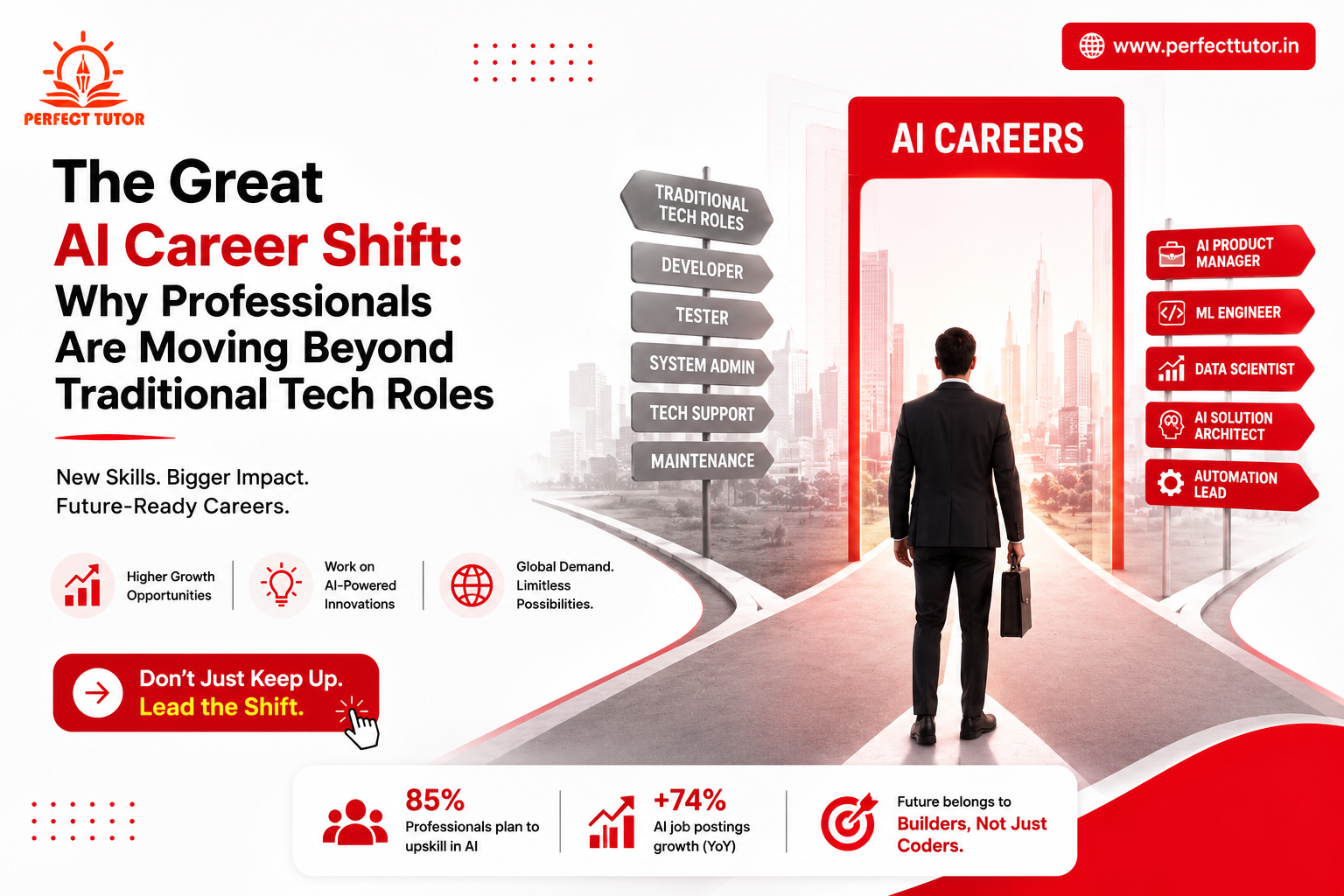
The Great AI Career Shift: Why Professionals Are Moving Beyond Traditional Tech Roles

The technology sector is producing a new kind of skills gap. Not a shortage of engineers, but a mismatch between the roles organisations built their teams around and the capabilities they now need to deploy AI at scale. Professionals who spent years developing expertise within defined technical functions are finding that the scope of those functions has shifted, and the pathways that once led to career advancement are no longer pointing in the same direction.
The scale of this transition is already visible in the data. According to ServiceNow’s AI Skills Research, Agentic AI is expected to redefine more than 10.35 million jobs in India by 2030, signalling one of the largest workforce transformations in the country's technology sector. According to McKinsey's State of AI report, 78 per cent of organisations now use AI in at least one business function, a figure that has moved from strategic priority to operational reality in under three years.
On the surface, this looks like a natural evolution of technical work. The reality is more structural. Organisations are not just adopting AI tools alongside existing workflows. They are rebuilding how work is performed around them, and the scope of what technical roles are expected to deliver is expanding faster than traditional postgraduate pathways were designed to accommodate.
The shift is not uniform. Professionals in engineering, data, and product roles are finding that their existing expertise remains relevant, but what they are expected to deliver with it has changed. Interconnected, system-driven environments now demand cross-functional execution rather than isolated technical contribution. As a result, the question for many professionals is no longer whether to engage with AI but how to reposition within it, a transition driving growing interest in the AI degree course and a new category of AI engineering colleges in India designed around execution.
The Growing Mismatch Between Traditional Roles and AI-Driven Work
Conventional technology roles were built around deterministic systems, defined workflows, predictable outputs, and function-specific ownership. AI fundamentally alters this foundation. Systems now operate on probabilistic outputs, continuous iteration, and evolving datasets. Professionals are expected to engage with real-world performance, system behaviour, and uncertainty in production environments, not just deliver within fixed parameters..
As organisations deploy RAG pipelines, agent-based systems, and enterprise copilots, the centre of work shifts from individual components to interconnected systems. Execution increasingly requires coordinating models, data, and infrastructure simultaneously. Narrow, function-specific expertise is proving insufficient in this environment. This mismatch is driving professionals to seek learning that builds system-level thinking, precisely the gap that AI engineering colleges in India are beginning to address through execution-led, industry-integrated curricula.
The Rise of Execution-Led Career Pathways
Career transitions into AI increasingly require more than acquiring technical knowledge. They require evidence that professionals can design, deploy, and operate complete systems across engineering, product, and business contexts.
Masters' Union's Postgraduate Programme in Applied AI and Agentic Systems reflects that shift through a full-time, 15-month curriculum structured around progressive capability building. Students spend four terms developing AI and machine learning foundations before choosing specialised pathways in AI Product, Advanced AI/ML & Systems, or AI Entrepreneurship. Every academic term culminates in a deployed system, allowing graduates to complete six production-grade AI projects covering autonomous agents, enterprise AI deployments, Retrieval-Augmented Generation (RAG), knowledge graphs, frontier and open-source models, and agentic applications.
As AI careers increasingly reward demonstrable capability over credentials alone, programmes centred on repeated execution are becoming more aligned with how organisations evaluate talent.
Industry Integration Is Reshaping How Professionals Transition
Career mobility increasingly depends on exposure to evolving production environments rather than static classroom instruction. AI infrastructure, deployment workflows, and tooling continue to change rapidly, requiring programmes to evolve alongside industry.
Masters' Union addresses this through curriculum updates every academic term with experts from Google, IBM, and PayPal, supported by collaborations with PwC and Rabbit AI. Students work within an active builder ecosystem featuring mentorship from more than 200 CTOs, founders, and AI practitioners, alongside build studios, hackrooms, collaborative sprints, and frontier technology initiatives. Final-term pathways allow learners to deploy Small Language Models, build Physical AI and multi-agent enterprise systems, or develop AI ventures of their own.
The result reflects a wider transition across AI education, where learning environments increasingly resemble modern engineering organisations rather than conventional postgraduate classrooms.